

Most E2 investors ask which path is right for them. The question that actually protects your capital is which mistake is cheaper to walk back.
Every E2 investor eventually sits down with the same two columns. Buy an existing business, or build one from the ground up. Most spend weeks weighing which one fits their personality, their industry background, their comfort with risk.
That is the wrong exercise.
The buy or build E2 visa business decision is not really a question of preference. It is a question of exposure. Both paths can fail. Both paths can succeed. The difference that actually matters is what it costs you, in time, capital, and visa standing, to reverse course if the path you picked turns out to be wrong. An investor who has already committed to the E2 decision sequence rarely stops to ask this. They ask “which one am I more excited about.” They should be asking “which mistake can I still afford.”
Key Takeaways
- Buy-or-build is not a personality question. It is a reversibility question: which path lets you correct course without losing everything already committed.
- Acquired businesses fail less often than startups because they pass through underwriting and due diligence filters startups never face, not because buying is inherently “safer.”
- Sunk cost thinking, not the original decision, is usually what turns a fixable misstep into an expensive one.
- The cost of switching paths mid-process is rarely just financial. It includes lost time, disrupted documentation, and momentum that is hard to rebuild.
- A defensible E2 business decision accounts for the exit before the entry, not after something has already gone wrong.
Why This Question Gets Skipped
I have sat across from investors who spent months comparing buy versus build like they were choosing a restaurant. Cuisine preference. Ambiance. What sounds more appealing.
Meanwhile, the actual decision in front of them was a structural one. It was about capital exposure, documentation dependencies, and how much of their timeline gets consumed if the first choice does not hold up.
This is not a criticism of the investors. It is a criticism of how the question usually gets framed for them. Most of the content available online, and most of the advice coming from people with something to sell, presents buy-or-build as a binary preference: are you a builder or an operator. That framing feels approachable, so people default to it. But it skips the part of the decision that actually determines financial outcome, which is what happens if the choice does not work out the way it was supposed to.
I have watched this play out with clients who committed to building a business, ran into a slower-than-expected ramp, and only then discovered how expensive it would be to pivot into an acquisition instead. The capital was already committed. The lease was already signed. The documentation already reflected a startup structure that would need to be rebuilt from scratch to reflect a purchase. Nobody sat down at the start and asked what reversing course would actually require. This is the same blind spot I described in why so many E2 business commitments fail: the failure point is rarely the initial choice, it is the absence of a plan for what happens if that choice turns out wrong.
What the Evidence Actually Shows About Buy vs. Build
The comfortable narrative is that buying an existing business is the safer path and building one is the riskier, more entrepreneurial path. The data supports part of that story, but not the reason most people assume.
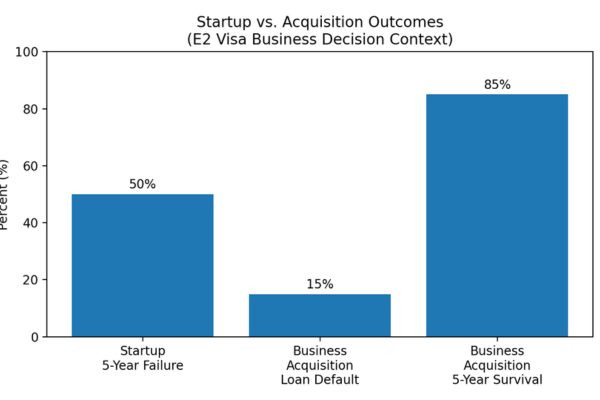
Bureau of Labor Statistics data from 2024 shows that roughly 20.4 percent of new businesses close within their first year, and 49.4 percent close by year five. That is the baseline risk of building from zero.
Acquired businesses fare better, but the reason is not that buying is magic. SBA lending data through 2025 shows that loans used to acquire an existing business default at a rate of roughly 1.93 percent, compared to 2.71 percent for other SBA loan purposes, a meaningfully lower default rate. Industry consensus among SBA lenders and business brokers puts five-year survival for acquired businesses that passed standard due diligence at 70 to 80 percent, well above the roughly 50 percent survival rate for startups over the same window.
The reason is structural, not magical. An acquisition already has a track record. It has passed through the filter of an owner willing to sell, a lender willing to underwrite the deal, and a buyer willing to verify the numbers before closing. A startup has none of that. It is an unproven hypothesis, and the biggest reason startups fail, lack of product-market fit, has not yet been tested when the money goes in.
That distinction matters for the buy-or-build question, because it reframes what “lower risk” actually means. Buying does not lower your risk of making a bad decision. It lowers your risk of discovering, after the fact, that the underlying business was never viable to begin with. Building carries the opposite risk profile: more creative control, but no external checkpoint forcing you to confirm demand exists before you are financially and operationally committed. This is the exact tension behind what E2 visa business viability really means, and it is worth understanding before either path is chosen, not after.
Reversibility, Not Preference
Here is what I want every E2 investor to sit with before they choose a lane: the right question is not “which path fits me.” It is “which mistake is cheaper to walk back.”
This reframe borrows from a concept economists have studied for decades. Daniel Kahneman and Amos Tversky’s prospect theory research showed that losses register roughly twice as painfully as equivalent gains, which is why investors cling to a failing path rather than formally realizing the loss and switching direction. Barry Staw’s organizational research on escalation of commitment documented the same pattern in businesses: decision-makers who feel personally responsible for a choice tend to pour more resources into it after it starts failing, not less, in an attempt to justify what has already been spent.
Neither of these researchers was writing about E2 visas. But the pattern is identical to what plays out with investors who picked a path, watched it wobble, and kept going anyway because stopping felt like admitting the first decision was wrong.
A reversibility-first framework flips the sequence. Instead of asking which path you prefer, you ask, before you commit a dollar: if this turns out to be the wrong business, what does correcting course actually cost me? For a startup, that might mean unwinding a lease, absorbing sunk marketing spend, and restructuring the business plan documentation that was built around a company that no longer exists. For an acquisition, it might mean walking away from a signed letter of intent during due diligence, which is far less costly, or discovering post-close that the seller’s numbers do not hold up, which is far more costly and harder to unwind.
The mistake is not usually the initial path. It is choosing a path without first pricing out what walking it back would require.
What a Reversibility-First Decision Actually Looks Like
A properly prepared E2 investor does not treat buy-or-build as a coin flip between two acceptable options. They treat it as a structural comparison of exit costs before they ever sign anything.
For a build path, that means understanding, before committing capital, how much of the investment is recoverable if the business does not hit its projected revenue in year one. Equipment can often be resold. A custom buildout usually cannot. A staffing plan built around an optimistic growth curve becomes a liability the moment growth slows, and unwinding it costs money, time, and credibility with the documentation trail an E2 case depends on.
For a buy path, that means understanding what due diligence will actually surface, and whether the deal structure allows you to walk away cleanly if it does not check out. Roughly half of letters of intent in small business acquisitions terminate during due diligence once financial discrepancies or undisclosed liabilities surface. That is not a failure of the process. That is the process working exactly as it should, which is precisely why the due diligence period exists before capital changes hands, not after.
This is the operational discipline I bring to every readiness engagement. I am not evaluating whether an investor prefers to build or to buy. I am pressure-testing whether they understand what reversing either choice would cost them in dollars, in time, and in how it lands with the documentation an E2 case depends on. An investment structure that cannot survive scrutiny on this point, the way I outline in does your E2 visa investment structure hold up, is not ready for submission regardless of which path it represents.
I am not an immigration attorney, and none of this is legal or immigration advice. How a particular business structure is evaluated during adjudication is a question for a qualified immigration attorney. What I advise on is whether the underlying business decision is operationally sound and documented well enough to withstand scrutiny, before an attorney ever builds a legal case around it.
Five Steps to Price Out Reversibility Before You Commit
Step 1: Write down the actual dollar cost of walking away at three checkpoints. Before signing anything, calculate what it costs to exit at the letter of intent stage, at the due diligence stage, and post-close for an acquisition, or at the lease signing, the buildout, and the first six months of operation for a startup. If you cannot produce a number, you do not yet understand your exposure.
Step 2: Separate sunk costs from future costs in writing. Every dollar already spent is gone regardless of what you decide next. List only the costs that change based on your next move. This single exercise stops more bad E2 business decisions than any pitch deck or business plan template ever will.
Step 3: Set a stop-loss threshold before you start, not after things go sideways. Decide, in advance, what signal would tell you the path is not working. Missed revenue targets by a set percentage. A due diligence red flag of a specific size. Write it down while you are still thinking clearly, because you will not be thinking as clearly once money and time are already on the line.
Step 4: Price the documentation cost of switching paths, not just the financial cost. An E2 business plan, source of funds narrative, and operational documentation built around a startup look nothing like the documentation required for an acquisition. If you switch paths mid-process, expect to rebuild a meaningful portion of your readiness materials from the ground up.
Step 5: Get a second, structured read on your exposure before you commit capital. This is where an outside readiness review earns its cost many times over. An investor too close to their own excitement about a deal is the worst-positioned person to price their own reversal risk objectively.
Frequently Asked Questions About Buy or Build E2 Visa Business Decisions
Is buying an existing business always the safer choice for an E2 visa investment?
Not automatically. Acquired businesses show stronger survival data, largely because due diligence and lender underwriting filter out weak deals before closing. But a poorly diligenced acquisition can fail just as fast as a poorly planned startup. Safety comes from the process, not the category.
How do I actually calculate which mistake is cheaper to walk back?
Price out your exit cost at each major checkpoint before you commit, not after. Compare what you would lose walking away from a startup lease and buildout against what you would lose walking away from an acquisition letter of intent or a post-close discovery. The lower number is your less expensive mistake.
Can I switch from building to buying, or the other way around, partway through the E2 process?
Operationally, yes, but it is costly. Expect to rebuild much of your business plan, source of funds narrative, and supporting documentation, since a startup case and an acquisition case are built around different evidence. Budget the time and cost of that rebuild before you assume a mid-course switch is simple.
Does buying a business make my E2 case stronger than building one?
That depends on how the case is documented and argued, which is a legal question outside my scope as a readiness advisor. What I can tell you is that a well-documented, operationally sound business, whether bought or built, is what withstands scrutiny. Consult a qualified immigration attorney on how your specific structure will be evaluated.
What is the single most expensive mistake investors make in this decision?
Committing capital before pricing out what reversing the decision would cost. Investors rarely lose money because they chose to buy instead of build, or the reverse. They lose money because they never calculated their exit cost until they were already inside a failing decision and sunk cost thinking took over.
Final Thought
The question you brought to this decision was probably some version of “which is right for me.” I understand why. It feels like the responsible question to ask.
It is not the question that protects your capital.
The investors I watch come through this process cleanly are not the ones who picked the perfect path on the first try. They are the ones who understood, before they committed a dollar, exactly what it would cost them to be wrong. They priced their exit before they signed anything. They separated what was already spent from what was still theirs to control. And when the moment came to decide whether to keep going or walk away, they made that call with a clear head instead of a sunk cost pulling the strings.
Buy or build was never really the question. The question was always whether you understood what you were risking if you got it wrong, and whether you built yourself a way out before you needed one.
If you want a structured, objective read on your own exposure before you commit capital to either path, an E2 Readiness Review is built for exactly this moment, before the decision, not after it.
The businesses that survive are rarely the ones that avoided every wrong turn. They are the ones built by investors who knew the price of turning around before they ever needed to pay it.
Keep Learning
- Should You Buy or Build an E2 Visa Business? – the foundational breakdown of the buy-or-build decision itself, for readers who want the full comparison before applying the reversibility lens in this article.
- What Is the Right E2 Visa Decision Sequence? – where the buy-or-build choice fits inside the larger sequence of E2 readiness decisions.
- Why So Many E2 Visa Business Commitments Fail – a closer look at the commitment failures that follow an under-priced decision.
- Does Your E2 Visa Investment Structure Hold Up? – a diagnostic look at whether your current investment structure could survive scrutiny.
Author Bio
Annett T. Block is an E2 business broker and advisor with lived E-2 operational experience since 1997. She helps committed investors evaluate, structure, and document U.S. business acquisitions and startups before legal submission, and supports long-term E-2 business sustainability through renewals and beyond. She is not an immigration attorney. For legal advice specific to your case, consult a qualified immigration attorney.