

What most E2 investors do not realize until a renewal is already at risk.
Most people who set up a U.S. business entity believe the hard work ends at formation. The LLC is registered, the EIN is obtained, the bank account is open, and the business is operating. What they do not track is what happens next, every single year, for as long as that entity exists.
Every state in the U.S. requires registered business entities to file an annual statement or annual report confirming basic information about the business. If you miss that filing, your state does not send a polite reminder. It starts a dissolution process. And if you want to stay compliant with your E2 visa, a dissolved or administratively terminated business entity is one of the fastest ways to put your status at risk.
This is not a hypothetical. It happens. And it usually happens to people who were otherwise doing everything right.
Key Takeaways
- Every state requires annual filings to keep a business entity in good standing. Missing them triggers dissolution proceedings.
- An administratively dissolved entity creates direct risk for E2 visa renewals and status maintenance.
- Deadlines, fees, and consequences vary significantly by state. There is no single federal standard.
- Tracking compliance is the investor’s responsibility, not the attorney’s, and not the registered agent’s, unless explicitly contracted.
- Business entity compliance is an operational habit, not a one-time checkbox.
Table of Contents
Why the Way You Stay Compliant With Your E2 Visa Matters More Than You Think
There is a version of E2 preparation that most consultants, attorneys, and online resources focus on: the application. Source of funds, business plan, investment threshold, substantial and non-marginal requirements. That is the front end of the process, and it gets most of the attention.
What gets far less attention is the operational layer that begins the moment approval is granted and does not stop until the business closes or the visa expires.
One of the most common (and most preventable) failures in that operational layer is missing an annual state filing.
The mechanics are straightforward. When you register a business entity in a U.S. state, you take on an ongoing obligation to that state’s Department of Corporations or equivalent agency. Most states require you to file an annual report confirming basic information: the business name, current address, registered agent details, and names of directors, officers, or managing members. Some states call it an annual statement. Some call it a biennial report. The label varies. The requirement does not.
When that filing is missed, states do not simply send a warning and move on. North Carolina, for example, issues a formal Notice of Grounds for Administrative Dissolution once the deadline passes. The business then has sixty days to remedy the situation. If the filing still has not been submitted after that window closes, the entity is administratively dissolved. At that point, the business has lost its legal protections, cannot legally transact business in the state, and faces significant complications with banking, contracts, and any regulatory filings that depend on active entity status.
Pennsylvania introduced new annual reporting requirements in 2024. Businesses that fail to comply by 2027 face initiation of dissolution proceedings and, critically, the potential loss of limited liability protections. Meaning the owner could become personally liable for business debts and lawsuits.
This is the operational environment E2 investors are operating in. And the immigration consequences layer on top of everything else.
What a Dissolved Entity Actually Means for Your E2 Status
The E2 visa is issued on the basis of a specific business enterprise. The investor’s status is tied to that enterprise being real, operational, and structurally sound. When a business entity is dissolved, even administratively, it raises a series of questions that no E2 investor wants to answer during a renewal review.
Is the business still operating? Can it legally operate? Is the investor still the controlling owner of a functioning enterprise? If the entity has been dissolved, the answers to those questions become complicated fast.
Heightened scrutiny during renewals and compliance checks is already a documented reality for E2 holders in 2025, even for those who have been in good standing for years. An investor walking into a renewal with an administratively dissolved entity is not simply explaining a clerical oversight. They are explaining a gap in operational credibility, which is precisely what the E2 standard is designed to assess.
The E2 standard requires that the investment support a real, non-marginal business. A dissolved entity, even if the business was otherwise functioning, creates a documentary contradiction. Officers of approval are trained to identify structural inconsistencies. A business that failed to maintain its state registration is a structural inconsistency.
To stay compliant with your E2 visa is not just about keeping the business profitable. It is about keeping every legal layer of the business intact. Entity good standing is one of those layers. It is not optional.
The E2 program issued 51,047 visas in fiscal year 2025, down from the prior year’s record of 55,324. That number represents tens of thousands of investors managing active E2 operations across multiple states with varying compliance calendars. The ones who do it well are not the ones who were reminded by their attorney at renewal time. They are the ones who built operational habits from the beginning.
What Actually Has to Be Filed and Where
The specifics vary considerably by state. There is no uniform federal standard for annual business entity reporting. Each state sets its own deadlines, its own fee structure, and its own consequences for non-compliance.
Some states tie the annual report deadline to the entity’s formation anniversary. Others require all entities to file by the same calendar date each year. Fees range from as low as ten dollars in some jurisdictions to several hundred dollars in others. The due date for a corporation in one state may be completely different from the due date for an LLC in the same state, or from the same entity type in a neighboring state.
This matters particularly for E2 investors who own businesses registered in more than one state, which is not uncommon. An investor operating in Florida and Nevada, for example, is tracking two separate filing systems, two sets of deadlines, and two different penalty structures. If a business is registered in multiple states, there are multiple deadlines to track, and missing any one of them carries the same risk of lost good standing or dissolution in that state.
The IRS underscores this as well. IRS Publication 583 emphasizes that businesses are responsible for maintaining accurate records of their business structure, registered entity information, and Employer Identification Number. All of which tie directly back to keeping the state entity in good standing.
What this means in practice is that staying compliant with your E2 visa requires tracking at the state level, not just at the federal level. Immigration status is federal. Business entity compliance is state. Many investors focus entirely on the federal dimension and overlook the state infrastructure that supports the entire enterprise.
Here is what you need to know about the primary states where E2 investors commonly operate:
California
Annual Statement of Information filed with the California Secretary of State. Deadlines vary by entity type.
Florida
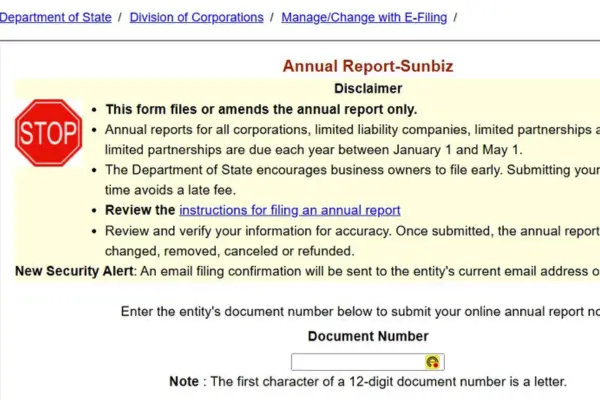
Annual report filed with the Florida Division of Corporations. Due May 1 each year. A late filing fee applies if submitted after the deadline. Failure to file results in administrative dissolution.
New York
Biennial report requirements for LLCs, with additional obligations for corporations.
Texas
No traditional annual report requirement, but franchise taxes and associated public information reports must be filed. Non-compliance affects business standing.
Nevada
Annual report filed with the Nevada Secretary of State. Nevada is commonly used as a formation state for its legal protections, but those protections require active maintenance.
For every other state, the filing authority is the state’s Secretary of State or equivalent Department of Corporations. The responsibility to find the correct filing system and calendar belongs to the investor. It does not automatically belong to the attorney, unless that relationship has been explicitly structured to include compliance monitoring.
What a Sustainable E2 Operation Actually Looks Like
Twenty-nine years of operating inside the E2 system teaches certain things that no guidebook or attorney consultation surfaces on its own. One of them is this: the investors who sustain their E2 status long term are not just better at the business. They are better at treating the business as an organism that requires ongoing maintenance, not a structure that was built once and left standing.
Entity compliance is one piece of that maintenance. It is not glamorous. It does not generate revenue or move the business forward in any visible way. But its absence can stop everything.
The structural approach to sustainable E2 operations includes establishing a compliance calendar at the time of formation, not at the time of the first renewal notice. It includes knowing which state you are registered in, when your report is due, what the fee is, who is responsible for filing it, and what the consequence is if it is missed. It includes building a documentation habit that makes every renewal review a straightforward presentation of a well-maintained enterprise rather than a scramble to reconstruct evidence of good standing.
To stay compliant with your E2 visa, the operational architecture has to function whether or not you are paying close attention to it in any given week. That requires systems. Not just intentions.
This is the distinction between investors who approach the E2 as a one-time immigration event and investors who treat it as a long-term operating commitment. The ones who last are the ones who built the second kind of structure from the beginning.
The ones who struggle are frequently the ones who got through the application process successfully and then assumed the compliance work was done.
It was not done. It had just moved into a different phase.
Frequently Asked Questions About How to Stay Compliant With Your E2 Visa
What happens if my business entity is administratively dissolved while I am on an E2 visa?
Administrative dissolution means the state no longer recognizes your entity as legally active. Your business loses its legal protections, cannot transact business in the state, and raises serious questions during any immigration review. Reinstatement is possible in many states, but it requires back filings and fees, and it does not erase the gap in your compliance record.
Who is responsible for tracking annual filing deadlines, my attorney or me?
Unless you have a written agreement with a registered agent or attorney that explicitly covers annual compliance monitoring, the responsibility is yours. Attorneys handle your immigration case. Entity compliance belongs to the operational layer of your business. Do not assume it is being managed unless you have confirmed that in writing.
Do all states have the same annual filing requirements for business entities?
No. Deadlines, fees, consequences, and filing systems vary significantly by state. California, Florida, Nevada, Texas, and New York all have distinct requirements. If your business is registered in more than one state, you are managing multiple compliance calendars simultaneously.
Does a missed annual filing affect my ability to renew my E2 visa?
A dissolved entity at the time of renewal creates a credibility gap in your case. Renewals require demonstrating an active, operating business enterprise. An entity that the state has dissolved does not clearly satisfy that requirement, and it will generate questions from reviewing officers that could complicate or delay the outcome.
Can I use a registered agent to handle annual filings on my behalf?
Yes. A registered agent service can track and submit annual filings on your behalf, typically for an annual fee. This is a reasonable operational choice, particularly for investors managing businesses in multiple states. The important step is confirming the service agreement specifies that filing responsibility explicitly before relying on it.
Final Thought
Most E2 investors think about compliance in terms of what the immigration system requires at the moment of application or renewal. Very few think about what the state requires from them every single year in between.
That gap is where preventable problems live.
The E2 visa is not a one-time transaction. It is an ongoing operational commitment, and the business entity at the center of that commitment has to be maintained at every level, not just the ones that are visible at the moment of review.
A missed annual report does not feel like an immigration problem the day it happens. It feels like a minor administrative oversight. It only becomes an immigration problem later, when the stakes are higher and the options are narrower.
If you want to stay compliant with your E2 visa, start by treating your business entity as the living, maintained structure it has to be. Not a legal shell that was built at formation and can run itself from there.
The E2 visa rewards operators who understand that approval is the beginning, not the finish line.
If you are not certain your entity is in good standing in every state where you operate, that is the right place to start. Book an E2 Readiness Review and let’s look at the full picture before a compliance gap becomes a renewal risk.
The strongest E2 operations are not built on momentum. They are built on maintenance.
Annett T. Block is an E2 business broker and advisor with lived operational experience inside the E2 visa system since 1997. She works with committed E2 investors to structure their readiness, documentation, and long-term operations before costly mistakes happen. She is not an immigration attorney. She is the operational voice between strategy and submission.
Reference Resources
IRS Publication 583 Starting a Business and Keeping Records: Supports the claim that businesses are responsible for maintaining accurate records of entity structure and registration status.
Florida Division of Corporations Sunbiz: Official filing portal for Florida annual reports, deadlines, and dissolution notices.
California Secretary of State Business Programs: Official resource for California Statement of Information requirements.
Nevada Secretary of State: Annual report requirements and entity maintenance for Nevada-registered businesses.
Texas Secretary of State: Texas franchise tax and public information report requirements.