

Most applicants plan around the government processing time. The government processing time is the smallest part of the timeline.
Avoid this mistake before your E2 investment ever leaves your bank account: assuming the visa clock starts when you file paperwork.
Here is the direct answer to how long does E2 visa take, start to finish. If you are planning relocation, budgeting your capital, or telling family and staff when you will arrive, the realistic range is 12 to 18 months from the day you decide to pursue E2 to the day you are operating your business in the United States. Not 3 to 6 months. Not the number your Google search returned in the first paragraph of someone else’s blog. Twelve to eighteen months, measured from decision to functioning operation.
That range breaks into five phases: business planning, capital and business acquisition, E2 preparation, the application itself, and business establishment after arrival. Each phase has its own timeline, its own risk of delay, and its own decisions that either compress or extend it. Most of the delay does not come from USCIS or a consulate. It comes from applicants who sequence their decisions backwards and then discover, three months into the process, that they are missing a piece they should have secured first.
Key Takeaways
- The realistic E2 timeline is 12 to 18 months from decision to business operation, not the 3 to 6 months most applicants assume.
- Government processing (USCIS or consular) is only one phase of five, and usually not the longest one.
- Business planning and capital or business acquisition together typically consume more time than the visa application itself.
- Rushing the front end of the timeline to compress the back end is the most common cause of a weak, RFE-prone application.
- A realistic timeline protects the applicant from panic-driven decisions that create real financial and legal risk.
Table of Contents
Why the Timeline Gap Keeps Catching Serious Investors Off Guard
The structural issue is not that people are bad planners. It is that the E2 process has no single published timeline, because the E2 process is not one process. It is five sequential phases, run by different parties, with different variables, and most public information about E2 timing only describes the government portion.
Search “how long does e2 visa take” and the answer that comes back is almost always about USCIS or consular processing alone. That is real information, but it is a fraction of the actual clock. Consular processing at a U.S. embassy currently runs anywhere from about 90 to 180 business days depending on the post, with high volume consulates like London or Mexico City running closer to 150 to 210 business days and lower volume posts clearing in 60 to 90 business days. Premium processing, when it applies, only speeds up the USCIS change of status route, and even then it guarantees a decision in 15 business days on the petition itself, not the full path to operating a business.
I have watched this play out the same way for close to three decades. An investor identifies a business, gets excited, and starts telling people a departure date before the business plan is even drafted, let alone before capital is sourced and documented in a way that will survive scrutiny. The date gets set based on hope, not sequence. When the right decision sequence is skipped, the visa timeline does not shrink. It just moves the delay to a later, more expensive stage, usually in the form of a Request for Evidence or a stalled business search.
But here is what most applicants never consider: the phases before you ever file anything are usually longer than the phases after you file. Business planning realistically takes two to three months if done properly. Finding and securing the right business, or structuring capital for a new venture, takes another two to three months on top of that. By the time you are ready to actually submit an application, half your realistic timeline may already be behind you, and you have not touched a government form yet.
What the Data Actually Shows About How Long E2 Visa Take Really Runs
The evidence here matters because it separates what applicants hope is true from what is actually happening at consulates and USCIS service centers right now.
Consular processing is the widest variable, and it is driven by interview backlog, not paperwork review. Current data from 2026 shows average consular processing running 90 to 180 business days from submission to visa issuance, with the spread almost entirely explained by which post handles the case. A well-prepared applicant at a low-volume consulate can clear the interview stage in six to nine weeks. The same applicant at a high-volume post can wait five to seven months for an interview slot, regardless of how complete the file is. Document review speed rarely explains the delay. Interview scheduling capacity does.
Premium processing solves a narrower problem than most applicants think. It only applies to Form I-129 change of status filings made from inside the United States, currently priced near $2,965, and guarantees adjudication within 15 business days. It does not apply to consular applications at all, and it does not shorten a Request for Evidence timeline in any way that removes the underlying problem. If USCIS issues an RFE, the clock pauses, the applicant typically gets roughly 87 days to respond, and a new 15-business-day window opens only after that response is received. A weak initial filing does not get faster because premium processing was purchased. It gets a faster no.
Standard USCIS change of status processing runs three to six months as of 2026, and adjudication has tightened noticeably since January 2025, with higher documentation scrutiny and more consistent RFE issuance on source of funds and business viability. This is directly relevant to how a business qualifies for E2 in the first place, because a business that cannot clearly demonstrate viability is now more likely to trigger the kind of RFE that adds 60 to 90 business days to an already long timeline.
Interview waivers have largely disappeared. Most E2 applicants, including many renewals, are now required to attend an in-person interview rather than qualifying for a waiver. That single shift adds real weeks back into a process that used to move faster for straightforward renewal cases.
Business establishment after visa issuance is rarely counted, and it should be. Opening bank accounts, securing a lease or closing on a purchase, hiring initial staff, and getting operational all take real time, typically two to four months depending on the type of business. An investor who counts their timeline as finished the moment the visa is stamped is still months away from actually operating a business.
What a Properly Sequenced E2 Timeline Actually Looks Like
The solution is not a faster government process. There is no version of this where an outside party accelerates a consulate’s interview backlog. The solution is sequencing the phases correctly so that the parts you control are not adding unnecessary time to the parts you do not.
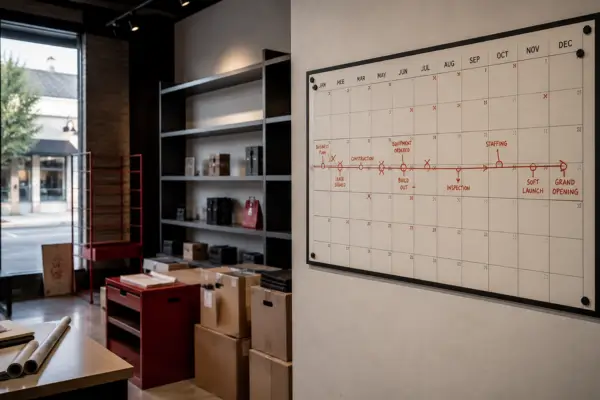
A realistic, defensible E2 timeline looks like this. Business planning and market validation: two to three months. Capital structuring and business identification or acquisition: two to three months, often running partly in parallel with planning. E2 preparation, meaning the business plan write-up, documentation of source of funds, and case assembly: one to two months. The application itself, whether consular or change of status: three to six months, driven mostly by factors outside your control. Business establishment after approval: two to four months. Add it up and the honest range is 12 to 18 months, and that assumes nothing goes sideways.
What compresses this timeline is not speed. It is sequence. Investors who decide whether to buy an existing business or build one from scratch early, before capital is even fully in place, tend to move through the middle phases faster because they are not making that decision under time pressure with a departure date already circulating. Investors who source and document capital cleanly before they need it for the application avoid the single most common trigger for a source of funds RFE, which by itself can add two to three months to a timeline that was already tight.
I have operated under E2 status for close to 29 years, and I have watched the same pattern repeat across three decades of investors: the applicants who build in real time for planning and capital work are the ones who do not end up scrambling six months in, discovering they needed a document they never gathered, or making an irreversible business commitment before their status was secured. The applicants who rush the front end almost always pay for it at the back end, in the form of an RFE, a missed interview slot, or a business decision made under pressure that they would not have made with a clear head.
This is where legal counsel matters, and where I stay firmly in my lane. I am not an immigration attorney, and nothing here is legal advice. How your specific case should be structured, what your particular consulate expects, and how to respond to an RFE if one arrives are questions for a qualified immigration attorney who knows your file. What I can speak to, from three decades of lived experience, is the business side: whether the business itself is structured to survive scrutiny, whether the documentation trail is clean before it ever reaches an officer’s desk, and whether the timeline you are building your life around reflects reality instead of hope.
Frequently Asked Questions About How Long E2 Visa Take
Is 12 to 18 months really accurate, or is that overly cautious?
It reflects the full path from decision to operating business, not just government processing. Some applicants move faster with clean documentation and a low-volume consulate. Others take longer. Treat 12 to 18 months as the planning range, not a guarantee in either direction.
Can premium processing bring the total timeline down significantly?
It speeds up one phase, the USCIS adjudication of a change of status petition, by guaranteeing a 15-business-day response. It does not apply to consular processing, does not prevent RFEs, and does not touch the business planning or establishment phases that often take longer than the government review itself.
What causes the most unexpected delay in a real E2 timeline?
Incomplete or unclear source of funds documentation is the most common trigger for a Request for Evidence, which can add 60 to 90 days. The second most common cause is applicants finalizing a business decision before capital and documentation are actually ready to support it.
Should I set a relocation date before I start the process?
Setting a hard date before your business plan and capital documentation are complete is one of the most common mistakes I see. It creates pressure to rush decisions that need time. Build your date estimate from the 12 to 18 month range once you are further into the process, not before you begin.
Is this something an immigration attorney should weigh in on early?
Yes. Legal counsel should be involved before you file, not after a problem surfaces. Timeline and business structuring questions are where I can help. Case-specific legal strategy, RFE response strategy, and adjudication questions belong with a qualified immigration attorney.
Final Thought
If you take one number away from this, let it be 12 to 18 months, not 3 to 6. Not because the longer number is discouraging, but because it is the number that lets you plan honestly instead of scrambling later.
Applicants who struggle are rarely the ones facing a slow consulate or a strict officer. They are the ones who told their family, their staff, or their landlord a date that was never realistic, and then made expensive, sometimes irreversible decisions trying to hit it. A realistic timeline is not a limitation. It is protection against the version of this process that costs you money, time, and options you did not need to give up.
Before you set a date, know what your business actually needs to be ready, what your capital documentation actually needs to show, and what phase you are honestly in right now. That is the work an E2 Business Review is built for, and it is where a rushed six-month plan becomes an honest, defensible eighteen-month one that holds up under scrutiny.
The E2 visa rewards investors who plan like operators, not like tourists on a deadline.
Annett T. Block is an E2 business broker and advisor with 29 years of lived E2 operational experience. She helps investors determine whether a business is genuinely viable for E2, assists with buying or selling E2 businesses, and supports the documentation needed to assemble a defensible E2 case before legal submission. She is not an immigration attorney. For legal advice specific to your case, consult a qualified immigration attorney.
Reference Resources
USCIS Case Processing Times: Official USCIS tool for current Form I-129 change of status processing time ranges by service center.
U.S. Department of State, Treaty Trader and Treaty Investor Visas: Official government overview of E2 visa eligibility and consular application requirements.