

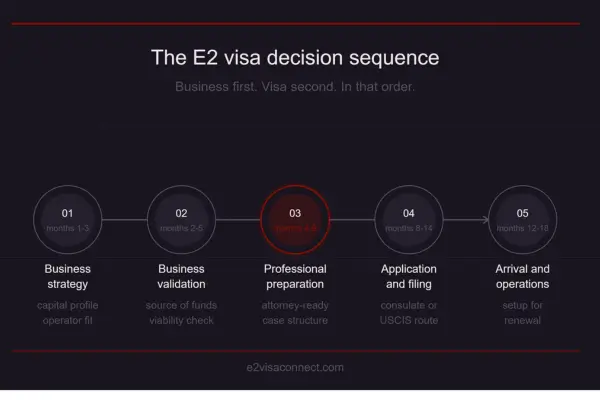
Most applicants are thinking about the E2 process backwards. Here is the order that actually protects your investment and your case.
Most E2 applicants approach the visa backwards. They find a business first, then try to figure out whether the business qualifies. They wire money before their source of funds documentation is organized. They call an attorney after the investment is already made. Then they wonder why the case is complicated, expensive, or weak.
The E2 visa decision sequence is not complicated in theory. In practice, almost everyone gets it wrong. Not because they are careless people. Because no one told them that order matters as much as the decisions themselves.
I came to the United States in 1997 on an E2 visa. We opened a hotel. I learned what the process actually requires, not from a checklist, but from years of living inside it. Nearly 30 years later, I still watch people repeat the same sequencing mistakes. They are avoidable. But only if you understand why the sequence matters before you start moving money.
This post is about the order of operations. Get it right, and your case is coherent, credible, and defensible. Get it wrong, and you are patching holes before you even file.
Key Takeaways
- The correct E2 visa decision sequence starts with the business, not the visa.
- Most applicants invest capital before validating whether their business choice actually qualifies.
- The realistic timeline for a properly sequenced E2 preparation is 12 to 18 months from decision to arrival.
- Rushing the sequence does not save time. It creates problems that cost more time to fix.
- An attorney cannot fix a poor business decision. The business has to be right before legal preparation begins.
Table of Contents
The Backwards Approach And Why It Is So Common
The most common E2 sequencing error follows a predictable pattern.
Someone hears about the E2 visa. They want to move to the United States. They start looking at businesses. Most often franchise opportunities, often businesses marketed specifically as “E2 friendly.” They find one they like. They get excited. They commit capital. Then they call an attorney.
That is backwards.
The E2 visa decision sequence should never start with a business search. It should start with an honest assessment of what you are trying to build, what capital you actually have, how that capital is documented, and whether your business type and investment amount can meet the requirements of the visa – not theoretically, but operationally.
The excitement of finding a business feels like progress. It is not. It is a commitment made before the foundational questions have been answered. And once capital is committed, the options narrow. You are no longer choosing the best approach. You are defending the approach you already took.
I have spoken with people in our community of 9,500 E2 members who were in exactly that position. The business was purchased. The money was gone. And then they discovered that the business structure, the investment amount, or the source of funds documentation created significant complications for their case. The problems were not impossible to address. But they were expensive, time-consuming, and entirely preventable.
The E2 visa decision sequence matters because it determines what options are available to you when problems arise. If you sequence correctly, problems surface early, when they can still be corrected. If you sequence incorrectly, problems surface late, when the only remaining option is to fix what is already broken.
The Problem with Emotional Timing
Sequencing errors are rarely careless. They are almost always emotional.
People want to move. They have a timeline in their heads. A school year they want their children to start in, a business opportunity they are afraid will disappear, a family situation creating pressure to act quickly. The urgency feels real because it is real. But urgency is a sequencing risk.
When people feel pressure to move fast, they compress the preparation phase. They skip business validation. They submit source of funds documents that are incomplete or inconsistently documented. They hire an attorney before they have a business worth presenting. They treat the attorney’s involvement as the starting line, when it is actually closer to the finish line of a properly sequenced preparation process.
According to published data from the U.S. Department of State, the E2 refusal rate in fiscal year 2024 was approximately 10%, with denial patterns consistently pointing to the same categories of weakness: investment not considered substantial, funds not clearly documented as at-risk, business plans that fail to demonstrate non-marginality. These are not random weaknesses. They are preparation failures. And preparation failures almost always originate from sequencing errors made months before the application was filed.
Consider what happens when an investor buys a business before validating whether it qualifies. They have now committed substantial capital to a specific business. If that business presents marginality concerns, the investor cannot simply swap it out. They are managing the case around a business that may not have been the right starting point. The attorney is working harder to build a defensible case. The documentation requires more explanation, more supporting evidence, more justification. And the applicant is paying for the complexity they created by deciding in the wrong order.
Compare that to an investor who validated the business type, confirmed the investment range, organized source of funds documentation, and then engaged an attorney to review a well-structured plan before committing capital. The attorney has something to work with. The case is coherent from the start. The preparation phase costs less, takes less time, and produces a stronger result.
For more on how weak business foundations create E2 case complications, see why E2 applications fail at the operations level.
The Correct E2 Visa Decision Sequence
The right E2 visa decision sequence is not a complicated framework. It is a discipline. It requires holding off on action until the earlier decisions are settled, even when that feels slower than you want.
Here is the sequence that produces a structurally sound E2 case, and a business that can survive not just approval but the renewals that follow.
Phase 1: Business Strategy Before Business Search (Months 1 to 3)
Before you look at a single business listing, answer the foundational questions. What type of business are you actually qualified to operate? What does your available capital look like, and how is it documented? What is your realistic investment range, not your ideal range, but what you can legitimately deploy as at-risk committed capital? What industry do you have the background to credibly direct?
These questions are not bureaucratic. They determine the shape of your case. An investor who cannot demonstrate they are qualified to operate the business they are buying faces scrutiny the business documentation alone cannot resolve.
Phase 2: Business Validation Before Capital Commitment (Months 2 to 5)
Once you have a realistic profile of the business type and investment range that fit your situation, identify specific business opportunities and validate them against E2 requirements before committing money. Is the investment substantial relative to the total cost of establishing this type of business? Does the business have a credible path to non-marginality? Is the operational structure one that requires your active direction, not passive management?
This is also the phase where source of funds documentation should be organized. Where did the capital come from? Is the trail clear, documented, and traceable from origin to the investment account? Source of funds problems that surface after capital commitment are among the most difficult to address because the money has already moved.
For a deeper look at what business selection actually involves at this stage, see whether your business would actually qualify for an E2 visa and the buy vs. build decision.
Phase 3: Professional Preparation Before Filing (Months 4 to 9)
With a validated business and organized documentation, engage a qualified immigration attorney. This is where legal preparation should start, not before. The attorney now has something coherent to build from. The business plan, the investment documentation, the source of funds narrative. These should all be substantially organized before the attorney begins case construction.
Note that I am not an immigration attorney and nothing in this post constitutes legal advice. The professional preparation phase requires qualified legal counsel. What I am describing is the operational readiness work that should happen before and alongside legal preparation, not in place of it.
Phase 4: Application and Processing (Months 8 to 14)
Consular processing typically runs 2 to 6 months for most consulates, though some high-volume embassies extend that timeline. USCIS change-of-status processing without premium processing runs approximately 4 to 6 months. Premium processing, which currently carries a fee of approximately $2,805, can bring a USCIS response within 15 calendar days, though that response may be an approval or a Request for Evidence, not necessarily a final decision.
As of late 2025, in-person interviews are required for virtually all E2 consular applicants. Interview waiver eligibility has been narrowed significantly. Planning for an in-person interview is not optional. Building it into your timeline is a sequencing decision that many applicants overlook until the appointment is harder to schedule than expected.
Phase 5: Arrival and Operational Setup (Months 12 to 18)
Approval is not arrival. Arrival is not the end of preparation. The first 30 to 90 days after arriving in the United States carry operational requirements that, if neglected, create complications at renewal. Banking setup, hiring structure, operational documentation, compliance records – these are not administrative details. They are the foundation of the renewal case you will need to build within the next two to five years.
For more on what the first 30 days after arrival actually require, see the E2 visa first 30 days after arrival.
What Happens When You Rush the Sequence
Rushing does not eliminate steps. It relocates the cost of those steps to a more expensive point in the process.
An investor who skips business validation and discovers at the attorney preparation stage that their chosen business presents marginality concerns now has three options: attempt to document around the weakness, change the business before committing irreversible capital, or proceed with a case that has a structural problem from the start. None of these options are as clean as validating the business before the commitment was made.
An investor who skips source of funds organization and realizes during attorney preparation that the capital trail is inconsistently documented now faces an extended preparation process, additional cost, and potentially a delayed filing while documentation is reconstructed.
An investor who files too early because the consulate has an opening they do not want to miss and submits an incomplete or weakly supported case faces a Request for Evidence, which according to published processing data can add 3 to 6 months to the overall timeline. The “fast” decision added time, not saved it.
The E2 visa decision sequence protects against these outcomes. Not by adding bureaucratic checkpoints, but by keeping the hard decisions at the front of the process, where they can be corrected, rather than at the back, where they can only be managed.
The businesses that build strong E2 cases are not the businesses that moved fastest. They are the businesses that were ready before they filed. Operational credibility is not something that can be assembled under deadline pressure. It has to be built in the right order.
For a clear picture of what operational credibility actually requires before submission, see the E2 visa pre-approval readiness diagnostic.
Frequently Asked Questions About the E2 Visa Decision Sequence
How long does the full E2 process actually take from decision to arrival?
A realistically prepared E2 case, from the initial decision to pursue the visa through arrival in the United States, typically spans 12 to 18 months. That includes business validation, source of funds organization, attorney preparation, and government processing time. Plans built around shorter timelines frequently create sequencing pressure that produces weaker cases.
Is it possible to start looking at businesses before my source of funds is organized?
You can look. But you should not commit capital before your source of funds documentation is organized. Once money moves, the documentation trail is set. If the trail is unclear, incomplete, or inconsistent before the money moves, organizing it afterward is more complicated and produces a weaker case than organizing it first.
When is the right time to hire an immigration attorney?
An immigration attorney is most effective when you bring them a coherent business and organized documentation. Hiring an attorney before a business is selected means paying for strategy that may need to be completely rebuilt once a business is chosen. The attorney should be part of the preparation process, not a substitute for it.
What happens if I discover my chosen business has a problem after I have committed capital?
Consult your business broker and immigration attorney immediately. The options available to you depend on how far the capital commitment has progressed, the nature of the problem, and your overall case posture. This is exactly the situation that proper sequencing is designed to prevent. For qualified legal guidance on your specific situation, work with a licensed immigration attorney.
Does applying for premium processing change the decision sequence?
Premium processing shortens the USCIS adjudication window, not the preparation timeline. If the case is not properly prepared, premium processing accelerates the arrival of a Request for Evidence or a denial, not an approval. The decision sequence does not compress because processing is faster. Preparation has to happen in full before filing, regardless of the processing track you choose.
Final Thought
The E2 visa decision sequence is not a bureaucratic formality. It is the structure that protects your investment, your case, and your time.
Most of the avoidable problems I have seen over 29 years of living inside the E2 process trace back to a single origin: someone made a decision before the conditions for making that decision were in place. They found a business before they understood their capital profile. They committed money before their documentation was clean. They filed before their preparation was complete.
The sequence cannot be undone once you have moved through it. Capital committed to the wrong business does not come back. A case built on a weak business decision does not become stronger because the attorney is skilled.
What can be done is to sequence correctly from the beginning.
If you are in the early stages of considering the E2 visa and want to understand where you actually stand before making any capital commitment, an E2 Business Readiness Review is the right starting point.
The sequence is the strategy. Get it right before anything else moves.
Annett T. Block is an E2 visa business broker and advisor with 29 years of lived E2 operational experience. She helps committed investors structure, organize, and prepare defensible E2 cases before legal submission and supports long-term E2 business sustainability through renewals and beyond. She is not an immigration attorney. For legal advice specific to your case, consult a qualified immigration attorney.